Showing posts with label alwyn cosgrove. Show all posts

Monday, July 13, 2009

Precision Nutrition Informal Experiment: Testing Results!

"History merely repeats itself. It has all been done before. Nothing under the sun is truly new. Sometimes people say, 'Here is something new!' But actually it is old; nothing is ever truly new. We don't remember what happened in the past, and in future generations, no one will remember what we are doing now."
- Ecclesiastes 1:9-11

As I mentioned in a previous blog, I was selected to participate in the Precision Nutrition Informal 8-Week Training Experiment.

I said that I would report the results of the study, and here - with the help of Helen Kollias of Precision Nutrition, Alwyn Cosgrove and myself - are the results.

In this study, we asked three questions. Which of these three programs:

-would most effectively improve performance?
-would most effectively promote weight loss?
-would people find most fun, and thus, stick with the longest?

Methods

The Testing
We compared the programs based on two indicators: body weight and performance.

Assessing body weight was easy: Participants simply recorded their weight once a week during the study. By the end of the study, we had nine body weight measurements to compare from week 0 to the end of week 8.

Measuring performance was a little more intensive. Before the study began, and after it ended, everyone did the following five performance tests:

1. Maximal push-up test
2. Inverted row test
3. Standing broad jump test
4. Treadmill V-max test
5. Treadmill T-max test

Thus, at the end of the study, we had before/after body weight measures as well as before/after performance changes to compare between groups for the entire 8-week study.

Who Was in the Study?
On average, participants in all three groups were in their early to mid-30's, although we had participants up to 70 years old (see table 1).

Table 1 – Average age (in years) of participants
Steady-state cardio
N = 17
Male = 35 +/- 6
Female = 34 +/- 11
Combined = 35 +/- 9

Interval cardio (I was in this group - I turned 34 going into this study)
N = 23
Male = 36.8 +/- 8.
Female = 31.0 +/- 6.8
Combined = 35.0 +/-8.1

TRX group
N = 16
Male = 33.2 +/- 7.3
Female = 36.4 +/- 8.1
Combined = 34.6 +/-7.6
Note: Once the participants were selected to participate in the study, they were matched and assigned to groups (I was in the interval training group) based on gender, age, weight and training experience. This meant that the groups were very similar to begin with, so any measured effects should be the result of the training intervention rather than individual differences.

Our participants had an average of 9 years' exercise experience (I have more than 15 years' experience). These people knew their way around the gym.

A Few More Things…
We wanted to make sure that the results reflected the exercise program, not other factors. So we asked our participants to make a few sacrifices in the name of science.

First, although we didn't have any dietary restrictions for the participants, we did ask anyone who was currently on a "bulking" diet (weight-gaining diet) to exclude themselves from the study or modify their diet.

Second, the participants couldn't do any other physical activities except activities required for everyday life.

Finally, anybody who had specific, short-term performance or body composition goals (such as a 5k race or a figure competition) were discouraged from participating, as this program was a general, not a targeted, plan. And we wanted to measure what our intervention alone could do.

Study Results

What Happened: Weight Loss
Interestingly, those in all three groups lost weight. Indeed, after 8 weeks, the average weight loss was about 3.2 lbs with no statistical differences between genders or groups. In other words, although all groups lost weight, any apparent differences in table 2 below are likely due to random chance rather than real differences.

Table 2 – Average weight loss (in pounds) over 8 weeks

Steady-state cardio
Male = -3.4 +/- 4.4
Female = -4.9 +/- 4
Combined = -4 +/-4.1

Interval cardio
Male = -2.9 +/- 3.8
Female = -0.6 +/- 2.2
Combined = -1.8 +/- 3.7
*I actually gained 6lbs in the first several weeks but then lost a few pounds during the last few weeks showing a net gain of 3lbs at the end of the 8 weeks!

TRX group
Male = +4.2 +/- 5.1
Female = -1.1 +/- 3.2
Combined = -2.8 +/- 4.5


What Happened: Performance
Along with weight loss, every group improved their performance — often impressively. (High fives to Alwyn.) But there were no statistical differences between genders or groups; remember, they all did the same strength workouts.

Table 3 – Average change in push-ups after 8 weeks

Steady-state cardio
Male = +9.8 +/- 7.2
Female = +11.7 +/- 5.5
Combined = +10.7 +/- 6.3

Interval cardio
Male = +10.1 +/- 6.9
Female = +2.7 +/- 6.7
Combined = +7.9 +/- 7.5
*I increased my pushups by 4.

TRX group
Male = +12.4 +/- 9.4
Female = +6.2 +/- 3.5
Combined = +9.8 +/- 7.9


Table 4 – Average change in inverted rows after 8 weeks

Steady-state cardio
Male = +4.8 +/- 2.0
Female = +6.9 +/-6.5
Combined = +5.7 +/- 4.6

Interval cardio
Male = +5.1 +/- 3.8
Female = +2.9 +/-1.2
Combined = +4.4 +/-3.3
*I increased my inverted rows by one rep.

TRX group
Male = +6.8 +/- 4.5
Female = +2.9 +/- 1.6
Combined = +5.1 +/-4.0


Table 5 – Average change in broad jump distance (in cm) after 8 weeks

Steady-state cardio
Male = +6.2 +/- 6.5
Female = +5.0 +/- 3.7
Combined = +5.7 +/- 5.3

Interval cardio
Male = +4.1 +/- 9.4
Female = +6.4 +/- 6.9
Combined = +4.7 +/- 8.7
*I had a 3-inch gain.

TRX group
Male = +4.8 +/- 3.0
Female = 2.6 +/-4.4
Combined = +3.8 +/- 3.8


Table 6 – Average change in V-max (% grade at constant speed) after 8 weeks

Steady-state cardio
Male = +1.2 +/- 1.2
Female = +1.7 +/- 1.1
Combined = +1.4 +/- 1.2

Interval cardio
Male = +1.4 +/- 0.9
Female = +1.9 +/- 1.1
Combined = +1.5 +/- 1.0
*I increased from 7mph at 5% incline to 7mph at 7% incline.

TRX group
Male = +1.4 +/- 0.6
Female = +0.3 +/- 0.5
Combined = +0.9 +/- 0.8


Table 7 – Average change in T-max (in seconds) after 8 weeks

Steady-state cardio
Male = +128.0 +/- 156.4
Female = +193.4 +/- 145.3
Combined = +160.7 +/- 149.0

Interval cardio
Male = +80.7 +/- 123.6
Female = +0 +/- 43
Combined = +53.9 +/- 112.3
*I actually had a decrease of 60 seconds but it was at the higher incline (7% instead of 5%).

TRX group
Male = +78.7 +/- 118.9
Female = +37.4 +/-63.9
Combined = +60.75 +/- 98.1


Fun Factor
While there wasn’t much of a difference between groups as far as weight loss and performance, we noticed a huge difference in the study drop-out rate. Steady-state cardio had a very high drop-out rate, while the TRX group participants were most likely to finish the study.

Table 8 – Drop-out rate

Steady-state cardio - 80%

Interval cardio - 55%

TRX group - 35%


Most research labs never have this sort of dropout rate. Because subjects are paid to participate and because they have to report to real-life people, they finish what they start. However, because our Informal Experiments are unpaid and distance-based, it's easy for participants to blow us off.

Sure, a few will let us know if something happened to exclude them from finishing. However, many of them simply ignore our emails. Even if we were kind enough to send them a workout plan — or even a TRX suspension trainer. Shame, shame. But, no matter. This is what explains the higher drop-out rates seen in a study like this.

However, we're not sure what explains the higher drop-out rate in the steady-state cardio group. For starters, five people in the steady-state group dropped out the day they received their programs. We figured this was because they assumed steady-state cardio sucks (which it does not, when combined with a good strength program). Again, shame, shame.

Of course, injuries are another possibility. But we didn't get more emails from the steady-state groups saying they were injured. For the most part, any injuries were evenly distributed and mostly non-exercise related (for example, we got a picture of a bruised toe to prove a ladder accident story.) So we doubt that was the problem.

The final explanation could be — simply — that steady-state cardio is kinda boring. Not everyone loves the idea of walking on a treadmill for 45 minutes. (Personal trainers everywhere, are you listening?)

Conclusions

Performance
All groups saw equal improvements in performance and weight lost. At least, statistically speaking. If you ask me, these improvements were excellent. For example, after just two months following the prescribed programs, participants improved their performance by an average of 30%.

This is especially awesome considering that, on average, these people had over 9 years' exercise experience. Why does this matter? The vast majority of exercise studies use participants with no training experience (untrained). And anybody who has trained can tell you that in the beginning you get the biggest improvement.

And yet, in this study, people who had already been exercising for over 9 years saw up to 30% improvement in some performance measures (push-ups, inverted row and T-max) in 8 weeks!

Why No Difference Between Groups?
Now, you probably noticed that for push-ups, rows, broad jumps, and V-max, the group means were pretty similar. That’s not unexpected.

While there is literature out there showing the effectiveness of interval training and other types of conditioning exercise vs. steady-state cardio for weight and fat changes, there isn't really any data showing that with a properly designed cross-training program, we should expect differences in key performance variables.

The steady-state group did seem to have better T-max scores. Now, again, statistically, there was no difference between groups. However, if there were a slight trend toward a higher T-max, a surrogate marker of anaerobic threshold and aerobic fitness, we would expect the groups that spent the most time on the treadmill to do the best.

So, what's the take home? Well, around here, most of us do interval training and circuit training (similar to the TRX work) for our conditioning exercise because we find theses types of exercises more challenging, and far more interesting than steady state cardio work.

Maybe this type of training just brings out the masochists in us; we usually alternate between states of:
  • Trying to survive the work interval without flying off the treadmill or getting tangled in our TRX
  • Dreading the end of the rest interval, thinking, "Is there something wrong with my watch?"
But I think that's what most folks want in a workout: challenge. And fun.

So, while the performance numbers weren't really different between groups, something more important was: actually doing the workouts. Remember, 80% of the people in the steady-state group dropped out. 55% dropped out in the interval group. And only 35% dropped out in the TRX group.

As Woody Allen said, "80% of success is just showing up."

Weight Loss
Participants lost, on average, 3-5 lbs without changing their diets. And if you think this isn't much, think again. Resent research has shown that exercise alone isn't very effective without some sort of nutritional change. In fact, many studies have shown no change if a nutrition plan isn't implemented. Check out this article for more.

The simple fact that weight loss occurred in all three groups of experienced exercisers is very cool.

Why No Difference Between Groups?
Although many people have pooh-poohed steady-state cardio for the last few years, when combined with a solid strength training program, steady state cardio can help folks lose weight and improve performance.

That's right: steady state cardio + strength training has been used – with much success – by physique champions for decades. It works. As does interval work + strength training. As does TRX work + strength training.

Thus, we weren't surprised at all that there were no differences between groups in terms of weight loss or performance. After all, they did about the same total duration of exercise – 4 sessions per week; 2×45 min strength sessions and 2×30-45 min conditioning sessions. So, when total workout times were equated, why should we expect to see anything different?

Now, we don't have body composition data, as described above. Had we collected those data, perhaps we'd have seen more subtle changes in fat mass and lean mass.

But, truthfully, I doubt it. All three programs included a strength training program and a similar volume of exercise. We have no reason to believe more muscle would have been built and fat lost with any specific intervention.

The Bottom Line

Here's how to interpret these results:
When you equate total exercise time, as long as you're doing an intense, progressive strength + conditioning exercise program, you can feel free to choose whichever program you like best.

If you prefer steady-state work, add it in. If you prefer interval work, add it in. And if you prefer TRX style workouts, add them in. Indeed, in this study, participants seemed to prefer the TRX style workouts. They loved the diversity and intensity associated with this program.

Of course, to do these workouts, you'd obviously need a TRX suspension trainer. Here's how you can get one:

TRX suspension trainer

And once you have your TRX system, know that as long as you have a great strength training program, feel free to add in steady-state cardio, TRX circuits, and sprint intervals to your heart's content.

===

Alwyn Cosgrove's comments:

I was actually a wee bit surprised with the results.

All the studies published on body composition show weight training to be superior to cardio, and interval training to be superior to steady state.

So I was expecting to see a clearer difference - but I guess the strength program in addition changes everything. Or at least the way I designed it (with supersets and short rest periods) had an effect.

I didn't see the TRX program until after I'd written the strength program, so there may have been some interference as there was some overlap between movements.

The drop out rate surprised me too. Like the PN guys said - it's an informal experiment but there is a real-world take home message for fitness professionals there.

One of the very interesting things was that the TRX group demonstrated similar improvements in running performance as both the interval training and steady-state groups. Without doing any running! That's a pretty good result.

I'd also like to have seen a group that did my program only, to see what those results alone were.

Informally - Right now our number one body comp program is two days strength, two days metabolic (combo of intervals, BW, KB's and TRX). We tested it against resistance training and traditional cardio and it was more effective in terms of pure body comp numbers.

(We also just had a group of women go through a 4-week cycle of TRX only training)

Overall, it was very cool to be involved with JB, the Precision Nutrition team and Fraser, and I look forward to doing more work with them.

AC

===

My comments:

I was also surprised that there wasn't a more distinct difference in performance between the three groups. As Alwyn mentioned, this may be due to the resistance training program that he designed.

Although some of my performance numbers weren't as high as the other males or the combined numbers for each group, they were all increases from the beginning of the program. Considering that I began training more than 15 years ago, those are some good improvements in a short period of time.

The fact that I gained weight almost as soon as I started the training experiment and for the first four weeks into the program is due to two things:
  1. I was performing less total exercise than what I was previously doing
  2. I had not reduced my caloric intake when I began the program
By the end of the eight weeks, my 6lb weight gain turned into a three-pound weight gain. I even lost the three pounds I had gained a few months later once I increased my training and continued to monitor my food intake and choices.

The biggest take-home point to this experiment is what Helen mentioned previously:

"When you equate total exercise time, as long as you're doing an intense, progressive strength + conditioning exercise program, you can feel free to choose whichever program you like best."


As I've said before, "Everything works. Nothing works forever."

When it comes to training, you have to find the things you enjoy doing but that also give you results. If you have plenty of time to exercise, then resistance training and steady-state cardio will work. If you are more time challenged, then resistance training and interval training or TRX circuits will work.

It all depends on your goals, the time you have available to train, your training experience, your compliance (fun factor) and your adherence to a proper nutritional program.

Friday, May 22, 2009

Are You Ready For Memorial Day Weekend?

"Keep asking, and it will be given to you. Keep searching, and you will find. Keep knocking, and the door will be opened to you. For everyone who asks receives, and the one who searches finds, and to the man who knocks, the door will be opened."
- Matthew 7:7-8

Here's a guest blog originally from Alwyn Cosgrove about Memorial Day weekend and being ready for summer. Take a good look in the mirror or take some photos and see where you're at and if it's where you want to be.

Well it's here - Memorial Day weekend.

The official start of Summer for many.

The great "unveiling" - when the shirts come off, the swimsuits go on and the entire world knows exactly how good or bad your dieting and exercising was for the last 3-4 months.

Judgement Day.

Are you ready? If not, you have two more BIG weekends this summer in which to dial in your physique and make a huge difference. That's right, it's not over! You still have two more Judgment Days this year!

Goal setting is all about setting S.M.A.R.T. goals and "T" stands for "Time line." Athletes peak for National Championships, Trials and World events. Just because you're training for fat loss or to look better naked doesn't change the fact that DEADLINES are extremely effective tools.

So we're going to set two this summer. Your next goal is Independence Day - July 4th - only five weeks away. With a combination of a kick-start plan, a solid workout and nutritional support program, and a healthy dose of motivation, you could easily be 10-15 lbs leaner by then.

Your next goal is the end of summer - the Labor Day weekend. This is currently 14 weeks away. So if you're looking a little flabby this weekend or feeling a little embarrassed about your physique, you can still make amazing changes. It's never too late.

This is an opportunity for you to look completely shredded - rock hard legs and abs by summer's end. But you still need to start now.

Here are the fat loss basics:

Calories
You need to create a caloric deficit. There are no two ways about it. You must burn more than you consume. The most effective way to create that deficit is to use a combination of diet and exercise.

Nutrition
Your diet should consist of lean proteins, fruits and vegetables. Keep starches and refined carbs to a minimum. Keep your fluid intake high (water only), and try to eat at least 4-5 small meals per day. This will help maintain blood sugar levels and keep you from blowing your diet.

Exercise
Interval training and metabolic resistance training will provide the most bang-for-your buck. Steady-state aerobic training just doesn't burn enough calories for your goals right now, and a bodypart training split will be less effective than total body training for fat loss. Try to exercise at least six days per week - three days of interval-based cardio and three days of resistance training.

Supplements
There is almost nothing that will make a difference. Sorry. Certain supplements can boost metabolism, or increase your energy somewhat and these may be useful. But in terms of real world "pounds of fat lost," I have yet to see anything that really made a difference. A multivitamin and a fish oil supplement are vital though - but more for your overall health. A protein shake or post-workout shake can be useful for convenience but are nothing more than high-quality food.

If you need a jump start - go HERE- this will take care of some fat quickly in the next four weeks.

P.S. All talk of fat loss aside, enjoy your holiday weekend. But PLEASE remember that the point of this weekend is to remember our fallen heroes and spare a thought for all the troops who are still fighting for us today.

God Bless!

Tuesday, May 19, 2009

Precision Nutrition Informal Experiment: 8-Week Training Study!

"Work hard and become a leader; be lazy and become a slave."
- Proverbs 12:24

In February, I was selected as one of 60 volunteers (30 male and 30 female) to participate in one of the Precision Nutrition Informal Experiments: 8 Weeks With Cosgrove and JB.

The experiment was set up as an 8-week training program that consisted of two strength training workouts and two conditioning workouts per week.

The Goal
The program was designed to look at the effects of three different strength and conditioning programs on fat loss and overall fitness. There were three similar, but distinct programs designed to boost performance and fat loss. The goal was to find which method was the most effective.

The three training groups were divided as follows (20 people per group - 10 male and 10 female):

Group 1
Two days of strength training and two days of steady state cardio

Group 2
Two days of strength training and two days of interval cardio

Group 3
Two days of strength training and two days of TRX conditioning circuits

The groups were divided based on age, training experience and other factors. I was selected to participate in Group 2.

All three groups followed the exact same strength training program twice a week, but each group followed a different conditioning and fat loss workout for the other two days of the week.

Testing
Prior to the start of the program, there were several tests that I had to complete including the following:

Maximal Push-Up Test
After a 5-minute warm-up, start this first test. This test is quite simple. Using a 2" sponge or yoga block as a depth marker, do as many consecutive push ups as you can. Start with the arms in full extension, descend to the depth marker, and extend back up. This counts as one repetition. Do as many as you can without resting. Once you're finished, record your number.

Inverted Row Test
With your feet elevated on a Swiss ball, box or bench and your arms gripping a barbell or smith machine bar, do as many inverted rows as you can. Start with your arms fully extended, pull up until your chest touches the bar and extend back down. This counts as one repetition. Do as many as you can without resting. Once you're finished, record your number.

Standing Broad Jump Test
Choose an open area and using a countermovement knee bend, jump as far forward as you can, going for maximum distance. Start with two practice jumps, aiming for about 80% of your maximum distance. Then, on your third jump, give it your all. Have someone mark where you landed and measure the distance from where your toes started to where they landed.

Treadmill V-max Test
Perform this one on a treadmill. Begin by running at 7-9mph (choose 7 if you're not a very good runner and 9 if you're a good runner) and 0% elevation. Every minute, increase the elevation by 1%. Continue this until you simply can't continue running. Go to complete exhaustion. Once you're finished, record the speed and elevation at which you stopped. These numbers represent your V-max.

Treadmill T-max Test
Come back to the gym rested and ready to run. After a 5-minute warm-up run, set the treadmill to your Vmax (speed and elevation recorded above). Run as long as you can. Go to complete exhaustion. Once you're finished, record the total time you lasted. This represents your T-max.

My pre-testing results were as follows:

Max Pushups = 43
Max Inverted Rows = 13
Standing Broad Jump = 95"
V-max Test = 7mph @ 5%
T-max Test = 270 seconds

8-Week Training Program
The training programs for each group were developed by Alwyn Cosgrove, Fraser Quelch of TRX Suspension Training and John Berardi.

During the first four weeks of the 8-week training program, I performed two full-body strength workouts on Monday and Thursday. Lower reps (6 or 6-8) were used to help preserve strength and muscle mass during the program. During the last four weeks, the strength workouts changed to one upper body workout (Monday) and one lower body workout (Thursday) using a similar set/rep scheme as the previous four weeks.

The interval cardio was performed on Tuesday and Friday. The intervals were performed on a treadmill set at the above-mentioned V-max setting (5% incline at 7mph) beginning with 25 minutes of intervals during the first two weeks, 30 minutes for weeks three and four, 35 minutes in weeks five and six and 40 minutes in weeks seven and eight. The intervals consisted of a 1:2 or 1:1.5 ratio of work to rest.

For example, conditioning workout A during the first week consisted of 30-second inclined treadmill intervals and 60-second rest breaks (1:2) for 25 minutes. Conditioning workout B consisted of 60-second inclined treadmill intervals and 90-second rest breaks (1:1.5) for 25 minutes. The interval workouts changed every two weeks (different work to rest periods and overall time - increasing from 25 minutes to 40 minutes during 8 weeks).

My Results
At the end of the 8-week experiment, my post-testing results were as follows:

Max Pushups = 47
Max Inverted Rows = 14
Standing Broad Jump = 98"
V-max Test = 7mph @ 7%
T-max Test = 210 seconds

The above shows that I improved in all areas. The one thing I could definitely tell was the difference in my conditioning when I played ultimate frisbee. Although I only increased my V-max from 5% to 7%, that 2% increase was significant on the field. I was able to run harder, faster and longer without tiring during the game.

However, I did not lose weight on the program. In fact, I gained three pounds overall after hitting a six-pound gain a couple weeks into the program and then slowly coming back down and holding a steady three-pound gain once the program was over.

Also, I retested my one-repetition maximum on several exercises once I completed this study to see if I had lost maximal strength. My bench was down by 10 pounds, my front squat was down five pounds, my standing overhead press was the same and my deadlift increased by 15 pounds.

The Next Step
At this time, I am waiting to see the final results of all three groups and how they compared. I think I know which group may have had the best conditioning and fat loss results, but we'll have to wait until John Berardi and the researchers with Precision Nutrition post the information. I will post the final results of the study in the next week or two.

Monday, May 18, 2009

Are You Ready To Bare All This Summer?

"So I saw that there is nothing better for people than to be happy in their work. That is why we are here! No one will bring us back from death to enjoy life after we die." - Ecclesiastes 3:22

Memorial Day is only a week away. For many, Memorial Day is the unofficial start to summer. It's a time for grilling out, going to the beach, pool, lake or springs and baring it all in your bathing suit or bikini.

Have you achieved your fat loss goals this year? Are you ready to wear your bathing suit and show off your beach body?

If not, there is still time to lose 10-20lbs and get in better shape before the next big summer holiday - Independence Day: July 4, 2009. Mark it on your calendar now!

You’ve probably heard of the rapid weight loss program - Warp Speed Fat Loss - as I used it last year with good results. Warp Speed Fat Loss is a complete 28-day diet and training system crafted to help you lose 10, 15 or 20lbs of body fat in just 28 days.

In fact, it's guaranteed that you will lose at least 10lbs or you'll get your money back plus an additional $20.

The guarantee is that if you use Warp Speed Fat Loss while charting your progress in the Faster Fat Loss Zone (Mike Roussell's fat loss membership site - you'll get a free 45-day membership when you purchase Warp Speed Fat Loss) and you don't lose at least 10lbs, they'll refund your order completely plus send you $20 via PayPal.

A 120% Money Back Guarantee.

That’s right. If you don’t lose the weight, Mike and Alwyn are going to give you your money back AND send you $20 for your trouble. Find out all the details here:

Warp Speed Fat Loss

Monday, March 16, 2009

Lose Fat in the Morning!

"Wisdom will multiply your days and add years to your life."
- Proverbs 9:11

This is an article originally written by Mike Roussell, Ph.D. I wanted to post it as today's blog since it gives good tips on how to begin losing fat first thing in the morning. It also goes with many of the recent blogs I've posted by Mike Roussell, Alwyn Cosgrove and the Warp Speed Fat Loss Program.

One of the best ways to ensure you burn maximum fat is to get your training done first thing in the morning. A common fat loss tip people often give out is just this - exercise in the morning to burn more fat.

Does exercising in the morning burn more calories? Unfortunately, there is no scientific evidence to prove that exercising in the morning burns more calories, but it may increase your fat loss.

How? Because it guarantees that you'll get your training done! If you are having trouble losing weight, sticking to your diet, and getting in all your exercise sessions, then training first thing in the morning could be just the thing for you.

In a previous episode of my Naked Nutrition Radio, my guest was behavior change expert Kara Mohr. Kara and her husband, Chris Mohr, hold exercise bootcamp for women in Louisville, Kentucky at 5:30 in the morning. Why? They call it the "No Excuse Hour." You don't have any excuses not to be there and not to do it.

My friend, and Men's Health expert, Bill Hartman exercises at 4:00am to ensure that he gets his training done - No Excuses. Bill runs two physical therapy clinics, a gym and is a family man. He has every reason to make excuses, but he makes the time.

Success Coach Brian Tracy always says that if you want to be successful, just find successful people and do what they are doing. If you are having trouble getting your training sessions in because your day is too busy, follow the example of these successful people and embrace the "No Excuse Hour."

You will feel invigorated, your metabolism will be blasting at its highest level, and you'll burn more fat.

The second important piece to the puzzle is diet. You need rock solid fat loss nutrition first thing in the morning to fuel your day. One important factor for many people (especially if they are exercising in the morning as well) is time. That is why I recommend you use a nutrition-packed shake to get fueled and get going with your day.

Here is a sample shake that you could make to help burn maximum fat:

Add to a blender: 8-12 ounces of water, a few ice cubes (optional), 1 ounce of walnuts, a "greens" supplement (such as Emerald Balance or Superfood), one scoop of protein powder (such as Metabolic Drive Low-Carb), and one cup of frozen berries (strawberries, blueberries, raspberries and/or blackberries).

Take 2-3 grams of fish oil while drinking this shake, and you'll be ready to go. This shake contains low-impact carbs, a blend of essential and heart-healthy fats, antioxidants, vitamins and minerals. You would be hard-pressed to find a better way to start your day and start burning fat.

You need to decide. Are you going to starting losing weight tomorrow morning? Are you going to take advantage of the "No Excuse Hour?" Are you going to start your day with a fat-burning breakfast - or coffee and a bagel like the rest of the country?

Jumpstart your fat loss first thing in the morning, and you will reap the benefits throughout the day.

About the Author/More Info
Warp Speed Fat Loss is a complete 28-day diet and training system crafted to help you lose 10, 15 or 20lbs of body fat in just 28 days. To start losing weight fast visit Warp Speed Fat Loss.

Mike Roussell is a nutrition doctoral student at the University of Pennsylvania. Mike's writings can be found in magazines such as Men's Health, Men's Fitness and Testosterone Nation. Mike specializes in fat loss nutrition and diets for busy men and women who need to lose weight fast without it interfering with their lives. Warp Speed Fat Loss is a complete Done-for-You A-Z Fat Loss Blueprint that gives you exactly everything you need to eat to lose weight in record time.

Saturday, March 14, 2009

The Problem With Weight Loss: Your Body Will Do The Opposite!

"My words are plain to anyone with understanding, clear to those with knowledge." - Proverbs 8:9

I've been very busy this past week and haven't had as much time to post some of the topics I want to discuss. So today's blog is an article written by Alwyn Cosgrove about weight loss with some ideas on how to get your body to respond favorably.

Homeostasis is the property of a living organism that regulates its internal environment so as to maintain a stable, constant condition.

When you don't drink enough water in the short term, often the body retains water. It attempts to maintain homeostasis by counteracting the stresses we put on it. When you drink a lot of extra water, your body excretes more water to maintain balance.

When we weight train, we actually break down muscle tissue. And the body responds by building new muscle. It attempts to maintain homeostasis by doing the reverse of the stimulus we placed on it.

When a male takes supplemental testosterone, the body shuts down its own production in a bid to maintain homeostasis.

When we immunize children against disease, we actually inject them with a small dose of that disease. The immune system recognizes the vaccine as foreign, destroys it, and "remembers" it. When the virulent version of an agent comes along, the immune system is thus prepared to respond. In order to prepare the body to defend against a disease, we expose it to the disease and it responds by doing the opposite - it destroys the disease.

In almost every situation I can think of, the body tries to maintain homeostasis by "doing the opposite" of the stimulus.

How does this apply to weight loss?
  • We now know that while you are performing low-intensity exercise, it burns primarily fat.
  • Higher intensity exercise actually burns more carb stores than fat.

But in every head-to-head comparison, high-intensity exercise results in more fat loss than low-intensity exercise even though the more intense work may burn a lesser percentage of fat during the exercise session. Burning glycogen results in a larger amount of fat lost than burning fat directly.

The body responds by doing the opposite:
  • It breaks down muscle to grow more muscle
  • It burns glycogen to lose more fat

I designed the Warp Speed Fat Loss training program to specifically take advantage of this law of nature so that when your body "does the opposite," you’ll end up with faster and greater fat loss.

About the Author/More Info
Warp Speed Fat Loss is a complete 28-day diet and training system crafted to help you lose 10, 15 or 20lbs of body fat in just 28 days. To start losing weight fast visit Warp Speed Fat Loss.

Alwyn Cosgrove, M.S., C.S.C.S., is a nationally-renown fat loss expert whose work has appeared in magazines such as Men's Health, Men's Fitness, Muscle & Fitness, Maximum Fitness, Men's Journal, Self, Oxygen, Muscle & Fitness HERS and T-Nation. His Warp Speed Fat Loss system is a complete Done-for-You A-Z Fat Loss Blueprint that gives you exactly everything you need to eat and exactly what to do for exercise to lose weight in record time.

Wednesday, March 4, 2009

Interval Training - Revisited!

"Therefore, since we are surrounded by such a huge crowd of witnesses to the life of faith, let us strip off every weight that slows us down, especially the sin that so easily trips us up. And let us run with endurance the race God has set before us."
- Hebrews 12:1

I've written about interval training and steady-state cardio in previous blogs including my most recent blog on how to combine interval training with steady-state cardio for the best fat loss results. However, I wanted to revisit the issue since it causes much confusion when someone is trying to lose fat or increase conditioning.

If you are limited in the amount of time you have to train, and you want to maximize your fat loss, then you will need to address your diet and resistance training program first.

As mentioned in the Hierarchy of Fat Loss, if you only have 3 hours to train each week, your diet and metabolic resistance training program will be the most important thing to address. However, if you have more time, you would want to include interval training and so on and so forth as described in the article.

As I've mentioned in previous blogs, I've also used the Tabata method. Although Tabata's may not be ideal for fat loss (although there could be that benefit over time), they are good for anaerobic conditioning. That's one reason why I recommend using them as a finisher after a weight workout. Tabatas are short, but intense and won't interfere with your weight training or strength and hypertrophy goals.

If your goal is to gain strength or size while maintaining your body fat levels (or possibly losing some fat), then short conditioning workouts like Tabatas work well.

I have also used the various methods posted in the Metabolic Acceleration Training blog for conditioning benefits. These are the methods that Alwyn Cosgrove has used with phenomenal results with his clients. And when it comes to research vs. real-world results, the real-world results prove their effectiveness.

There are also countless studies showing the benefits of intervals for fat loss and conditioning over traditional steady-state aerobic exercise. In fact, Alwyn Cosgrove put many of those studies in his Real World Fat Loss manual and DVD (many of which are also posted on his blog).

The reality is that there are not as many studies proving the effectiveness of the various metabolic acceleration methods he (and others) has used - but again, real-world results trump what the research says. And if he is training more than 200 people each year at his facility and has been doing so for more than 10 years and has found those methods to be the most effective for the thousands of people he's trained, that says something!

Not only that, but from my own experience and experience training others, these various methods work far better than what I see the majority of people doing in the gym.

Putting It All Together
Designing a HIIT workout shouldn't be too difficult. You're going to alternate periods of high intensity with periods of moderate or low-intensity for your recovery. This, of course, will be dependent on your fitness level and is fully adjustable as needed.

For example, if you can't sprint for the time required, you could jog or perform a fast walk for your "intense" portion of the interval and then walk for your rest or recovery portion.

Another benefit to interval training is that it doesn't require a lot of time. Many people will start out with as few as three intervals for a total workout time of 9-10 minutes (after your 3-5 minute warm-up). As for how often to perform interval training, I recommend anywhere from 1-3 days each week depending on the time you have available and your goals.

You can use a variety of methods for interval training (sprinting or jogging, jumping rope, weight circuits, bodyweight exercises, stationary bike, stair climber, rower, etc.) and you can use different work-to-rest ratios to make them more or less intense.

Typical work-to-rest ratios will be 1:2, 1:1.5 or 1:1. Which one you use will depend on your level of conditioning and goals. It would be a good idea to start with a 1:2 work-to-rest ratio and progress over time to 1:1.

Some of the most common work-to-rest ratios include the following:
  • 30 secs "hard" (8-9 out of 10) with 60 secs "easy" recovery (4-6 out of 10)
  • 30 secs "hard" with 45 secs "easy" recovery
  • 30 secs "hard" with 30 secs "easy" recovery
  • 45 secs "hard" with 90 secs "easy" recovery
  • 45 secs "hard" with 75 secs "easy" recovery
  • 45 secs "hard" with 45 secs "easy" recovery
  • 60 secs "hard" with 120 secs "easy" recovery
  • 60 secs "hard" with 90 secs "easy" recovery
  • 60 secs "hard" with 60 secs "easy" recovery
  • 90 secs "hard" with 180 secs "easy" recovery
  • 90 secs "hard" with 90 secs "easy" recovery
  • 120 secs "hard" with 120 secs "easy" recovery
From what I've researched (Alwyn Cosgrove and Craig Ballantyne seem to have the most information), 60-second "hard" intervals seem to be the most effective for fat loss. But 30- and 45-second intervals are also effective. I've used intervals ranging from as little as 10 seconds (using a Tabata-type interval) up to 120 seconds.

A sample interval training program for someone new to this type of exercise would be as follows:
  • Warm-up: 3-5 minutes (fast walk, jog, bike, bodyweight circuit, etc.)
  • Interval 1: Perform 30-second "hard" (8-9 out of 10) interval
  • Recovery 1: Perform 60-second low-to-moderate-intensity (4-6 out of 10) recovery period
  • Interval 2: Perform 30-second "hard" interval
  • Recovery 2: Perform 60-second low-to-moderate-intensity recovery period
  • Interval 3: Perform 30-second "hard" interval
  • Recovery 3: Perform 60-second low-to-moderate-intensity recovery period
  • Cool down: Perform 3-minute walk, slow jog, bodyweight circuit or bike
That's just one way to start out using a 1:2 work-to-rest ratio and a 30-second "hard" interval with a 60-second "easy" recovery period. For more ideas, see my blog How to Perform Interval Training.

In addition, here's a good article that John Berardi posted on his blog today about the topic of interval training, steady-state cardio and how to progress: Exercise Progressions

If you have any questions, let me know!

Thursday, February 19, 2009

Fat Loss Basics!

"Commit yourself to instruction; listen carefully to words of knowledge." - Proverbs 23:12

This is an article originally written by Alwyn Cosgrove. I wanted to post it as today's blog since it gives good information on how to lose fat. You'll see that many of the points he makes go along with previous blogs I've written about effective ways to lose fat through a proper diet (lower carb) and exercise (higher intensity).

How do we actually lose fat? What do we mean by fat "burning?" Here's a very simple explanation of what actually goes on to create a fat-loss effect.

The key concept that trainers and physiologists have shoved down our throat for years is that it's all about calories in vs. calories out. This is true – for weight loss – but it's not the whole truth for fat loss. There are a number of protective mechanisms that the body has in place – called rate-limiting steps – to prevent fat from being lost or burned.

On a very basic level, Fat "burning" is essentially a two-step process.

The first step is mobilization.

How do we actually get fat out of the fat cells so that we can subsequently use it as a fuel source? Fat mobilization is governed essentially by levels of a hormone known as hormone-sensitive lipase or HSL (you can forget the name as there won't be a test). It's an oversimplification but basically the higher the HSL levels, the higher the fat mobilization.

How do we get higher HSL? Increase catecholamine levels (specifically adrenaline). How do we do that? Exercise. Particularly, high-intensity exercise.

But HSL is also limited by insulin.

High insulin levels = Low HSL levels = Low fat mobilization.

A great strategy for part one is low insulin levels (from diet and training), plus high catecholamines (through intense training).

Part two of the process is transport and oxidation.

If HSL levels are high, fat cells break down into free fatty acids (FFA) which circulate in the blood and eventually end up in a muscle (which needs energy) where they can be burned off in the mitochondria (this is the "powerhouse" of the cell that your high school biology teacher kept going on about).

But there's another rate-limiting step here: Transporting the FFA into the mitochondria where it can be burned off. That transport is controlled by carnitine levels.

If carnitine levels are high, fat transport is high. Think of carnitine like passport control officials.

If you get off a plane with 500 other passengers and there is one official at passport control, it'll take a long time to get through. If there are 500 officials, then you go through quickly and can leave the airport (leaving the airport is the equivalent of fat being burned off). The more officials (carnitine), the easier the process.

How do we ramp up carnitine levels? Well, again, we have a rate-limiting step. If muscle glycogen is high, then carnitine levels are low.

If we reduce muscle glycogen through metabolic work, we have the optimal fat-oxidation state. Therefore, high-intensity glycogen depleting exercise is the tool of choice here.

High levels of fat mobilization + High levels of fat oxidation = Accelerated fat loss.

If you figure out how to integrate all those steps, and circumvent each rate-limiting step, you’ll find that fat loss is simple.

So how do you put all of those steps into effect so that fat loss becomes simple? One way is to follow a proper training and nutrition program like Warp Speed Fat Loss.

About the Author/More Info
Warp Speed Fat Loss is a complete 28-day diet and training system crafted to help you lose 10, 15 or 20lbs of body fat in just 28 days. To start losing weight fast visit Warp Speed Fat Loss.

Alwyn Cosgrove, M.S., C.S.C.S., is a nationally-renown fat loss expert whose work has appeared in magazines such as Men's Health, Men's Fitness, Muscle & Fitness, Maximum Fitness, Men's Journal, Self, Oxygen, Muscle & Fitness HERS and Testosterone Nation. His Warp Speed Fat Loss system is a complete Done-for-You A-Z Fat Loss Blueprint that gives you exactly everything you need to eat and exactly what to do for exercise to lose weight in record time.

Tuesday, February 17, 2009

Combining Interval Training with Steady-State Aerobic Exercise for Fat Loss!

"But those who trust in the Lord will find new strength. They will soar high on wings like eagles. They will run and not grow weary. They will walk and not faint." - Isaiah 40:31

In previous blogs, I've spoken about the effectiveness of interval training for fat loss. For a summary, check out these blogs:

Nutrition Tips, Aerobic Exercise and High Intensity Interval Training

More on Interval Training for Fat Loss

Tabata Interval Training

Burn Fat and Increase Metabolism with Resistance and Interval Training

How to Perform Interval Training

Metabolic Acceleration Training - A Better Way!

Warp Speed Fat Loss (combines interval training and metabolic strength training)

It's been proven that interval training works - and works well - for fat loss. However, there are many people who still enjoy steady-state aerobic exercise such as walking, jogging, swimming and bicycling. Although steady-state aerobic exercise is on the lower end of effectiveness in the hierarchy of fat loss, it can still be used for cardiovascular benefits and fat loss if you have more time to train.

Another effective way to get the fat loss you desire is to combine interval training with steady-state aerobic exercise. Alwyn Cosgrove has used this with many of his clients and in some of his training programs including those listed in his book The New Rules of Lifting for Women and Warp Speed Fat Loss.

The best way to combine the two methods is as follows:
  • Perform a five-minute warmup (bodyweight circuit, fast walk, jump rope, light jog, bike, etc.)
  • Perform interval training (9-20 minutes total depending on the intervals chosen)
  • Stop and rest for five minutes (this gives the body time to release the triglycerides into the bloodstream so you can burn them off with steady-state aerobic exercise)
  • Perform 20-30 minutes of moderate intensity aerobic exercise (fast walk, light jog, bicycling or perform on various aerobic exercise equipment - treadmill, stationary bike, stair stepper, rower, elliptical, etc.)
Using this combination of interval training and steady-state aerobic exercise seems to be the most effective way to accomplish your fat loss goals while also increasing your conditioning and fitness levels.

I would recommend using this method 2-3 times each week depending on your training experience in addition to 2-3 days per week of resistance training (see this blog on how to set up an effective metabolic resistance training program). Depending on how much time you have available to train, you could set it up like this:

Monday - Full-body Metabolic Resistance Training (30-60 minutes total time)
Tuesday - Intervals + Steady-State Aerobic Exercise (30-50 minutes total time)
Wednesday - Off or light activity, walk the dog, play with the kids
Thursday - Full-body Metabolic Resistance Training (30-60 minutes total time)
Friday - Intervals + Steady-State Aerobic Exercise (30-50 minutes total time)
Saturday and Sunday - Off or light activity, walk the dog, play with the kids

The above schedule requires four days and approximately 2-4 hours of exercise per week. That is not a huge time commitment and it also gets you very close to the five hours per week that is recommended by most fitness experts.

If four days per week is not possible, you can adjust the schedule so that you perform your interval training and steady-state aerobic exercise after your metabolic resistance training workouts. You could set it up for two days per week like this:

Monday - Full-body Metabolic Resistance Training (30-60 minutes total time) and Intervals + Steady-State Aerobic Exercise (30-50 minutes total time)

Thursday - Full-body Metabolic Resistance Training (30-60 minutes total time) and Intervals + Steady-State Aerobic Exercise (30-50 minutes total time)

The only negative to the above schedule is that you will need to devote approximately 1-2 hours each training session - and it can be hard to accomplish that much work in one session unless you are already well conditioned.

Or you could divide it up over three days per week like this:

Monday - Full-body Metabolic Resistance Training (30-60 minutes total time) and Intervals + Steady-State Aerobic Exercise (30-50 minutes total time)

Wednesday - Full-body Metabolic Resistance Training (30-60 minutes total time)

Friday - Full-body Metabolic Resistance Training (30-60 minutes total time) and Intervals + Steady-State Aerobic Exercise (30-50 minutes total time)

There are other ways to adjust the schedule to fit your time constraints and availability. But you must make the time (turn off the TV, get off the computer, play less video games, eliminate time-wasting activities) and put in the effort and consistency to reap the benefits. And, of course, your nutrition program needs to complement your training to get the best results.

If you have any questions, please feel free to comment below. I can always give you suggestions and sample programs to follow to help accomplish your fat loss goals no matter what your training experience may be or what equipment you have available.

Thursday, February 12, 2009

Warp Speed Fat Loss - Lose 10lbs in 28 Days or Get $20 Back!

"Dear friend, I hope all is well with you and that you are as healthy in body as you are strong in spirit." - 3 John 1:2

I’ve never seen anything like this before! Nutritionist Mike Roussell and Men’s Health Fat Loss Expert Alwyn Cosgrove have put their money where their mouth is…LITERALLY.

You’ve probably heard of the rapid weight loss program - Warp Speed Fat Loss - as I used it last year with good results. Warp Speed Fat Loss is a 28-Day blueprint for people that want to lose up to 20lbs in 28 days. It works like gang busters.

The story goes like this:

Mike was talking to his Dad the other week and his father didn’t think that people would believe that it was possible - being able to lose up to 20lbs in 28 days. Especially with all the exotic berry and weight loss scams all over the internet.

So Mike decided he needed to figure out a way to help overcome the seed of doubt in people’s minds (because the program really does work).

Do you know what he came up with?

A 120% Money Back Guarantee. The guarantee is that if you use Warp Speed Fat Loss while charting your progress in the Faster Fat Loss Zone (Mike Roussell's fat loss membership site - you'll get a free 45-day membership when you purchase Warp Speed Fat Loss) and you don't lose at least 10lbs, they'll refund your order completely plus send you $20 via PayPal.

Warp Speed Fat Loss

That’s right. If you don’t lose the weight, Mike and Alwyn are going to give you your money back AND send you $20 for your trouble.

Find out all the details here:

Warp Speed Fat Loss

P.S. Just in case a bunch of dishonest people take Mike and Alwyn up on this so they can get $20, Mike and Alwyn have limited the offer to the first 100 people.

Go Here Now So You Don’t Miss Out - Warp Speed Fat Loss!

Saturday, February 7, 2009

Program Design Tips!

"For the waywardness of the naive will kill them, and the complacency of fools will destroy them. But he who listens to me shall live securely and will be at ease from the dread of evil."
- Proverbs 1:32-33

If you have been resistance training for a year or two and have knowledge of how to perform various exercises but don't feel satisfied with your results, then it may be time to develop a training plan to help you make consistent progress in the gym.

Most beginners and intermediates go to the gym and perform whatever exercises they feel like doing on that particular day. I have seen many people follow a bodybuilding program where they perform chest and triceps one day, back and biceps another, legs one day (if they actually work their legs) and shoulders, calves and abs another day.

This is only one variation of many that I have seen that require a minimum of four days per week devoted to resistance training in addition to any type of energy system development or cardio that they perform in addition to the resistance training workouts. When you add it all up, it requires 6-7 days devoted to training at approximately 60-90 minutes per session. I don't know about you, but I just don't have time to train that often!

There are a few problems with a bodybuilding training plan if you're not a bodybuilder or don't have plans to compete as a bodybuilder or want to look like a bodybuilder:

  • First, if you are a beginner or intermediate lifter, you may not see many results after your first few months of training. Once your body adapts to the exercises and overall volume and frequency, it will stop making gains. At this point, many lifters try to add more volume to their workouts or add additional workout days.
  • Second, most people that want to get in shape don't have four, five or six days to train (which is typical of most bodybuilding programs). If you have problems getting to the gym more than three days each week, a bodybuilding program is not going to give you the best results.
  • Third, a bodybuilding program typically has the lifter performing long workouts with a high amount of volume while targeting each bodypart once per week. For those of you who are time challenged, then this type of workout plan won't help you get the results you want in the time you have available.
  • Fourth, most people don't want to look like a bodybuilder. Many people prefer a more athletic physique and want to lose fat, gain strength and muscle, have some sort of athleticism and be healthier than they currently are. If this sums up your goals, then a bodybuilding training plan won't help get you where you want to go.

There are more reasons why a bodybuilding training plan is not ideal for most people (other than bodybuilders), but the above bullet points give you something to think about.

I was speaking with a friend recently that asked me for some tips on what she should be doing in the gym. This is what I recommended, and it's a good way to help you design your own training plan so you can continue getting the results you want to meet your goals.

Program Design 101

First, keep it simple. How many days do you have available to train at the gym (or at home if you have a home gym)? How much time can you devote to training each session? If you have 30-60 minutes, two-to-three times per week, then the following tips will be very useful for you.

If you can perform 2-3 resistance training workouts each week, then I would recommend using two full-body workouts (A and B) that you can alternate 2-3 times each week. The A-B split, as it is known, was popularized by Charles Staley (for a good article and sample training plan suited for intermediate and advanced trainees, see this article).

For the "A" workout, choose a leg exercise (squat variation), a horizontal push variation (bench) and a horizontal pull variation (rowing) as your three main exercises. Perform as a circuit moving from one exercise to the next with fairly short rest periods (sets/reps to come). Finish the "A" workout with some arm and ab exercises (keep it under 10 minutes total).

For the "B" workout, choose a leg exercise (deadlift variation), a vertical push variation (overhead presses) and a vertical pull variation (chins/lat pulldowns). Do them as a circuit like the A workout. Finish with some abs and arm or extra shoulder/upper back/rear delt exercises (keep it under 10 minutes).

For the sets and reps, try something like this:

Day 1: 4x6 or 5x5 (make this your heavy day)

Day 2: 3x8, 3x10 or 3x12 (this is your medium day)

Day 3: 2x20 or 2x15 (this is your light day)

The reason I like to use different sets and reps each day is because your body can only handle so much heavy lifting. By dividing your days into heavy, medium and light, it will help prevent potential overuse issues and joint pain and problems.

It also helps keep your body from adapting too quickly to the workouts while helping you train for strength, hypertrophy (muscle gain) and strength endurance (or speed strength) all in the same week. This is a term called undulating periodization and has been popularized by Alwyn Cosgrove (see this article for more information and tips).

Using the above sets and reps, you can alternate your "A" and "B" workouts like this:

Week 1

Day 1: "A" workout (sets/reps above, i.e. 4x6 or 5x5)

Day 2: "B" workout (sets/reps above, i.e. 3x12 or 3x10)

Day 3: "A" workout (sets/reps above, i.e. 2x20 or 2x15)

Week 2

Day 1: "B" workout (sets/reps above, i.e. 4x6 or 5x5)

Day 2: "A" workout (sets/reps above, i.e. 3x12 or 3x10)

Day 3: "B" workout (sets/reps above, i.e. 2x20 or 2x15)

Weeks 3 (same as week 1) and Week 4 (same as week 2).

At the end of week 4, you would change the exercises for your next four-week phase and change sets/reps so you don't perform the exact same set/reps as your previous training block.

You can continue to use this type of training template for a long time and make consistent gains (or losses if you are trying to lose fat)!

One benefit to the training template above is that you only repeat each workout every three weeks. This makes it hard for the body to adapt and also helps keep your motivation high knowing that you don't repeat the exact same workout too frequently while still seeing results.

You can perform your cardio or interval training after your resistance training workouts for conditioning and fat-loss benefits or on your "off" days depending on how much time you have available to train each week. You can easily adjust the above template to fit your time constraints.

If you only have 30 minutes to train, perform a general 5-minute warm-up and then perform one warm-up set for each of the three exercises in your circuit. Rest 1-2 minutes and then perform your work sets for each exercise for the amount of sets/reps required that day.

Since you will be using compound exercises that hit more muscles of the body, you will get a sufficient full-body workout using only three main exercises each workout requiring only about 30 minutes.

If you have more than 30 minutes, then you can add the extra arm, shoulder and ab exercises that I listed previously and also devote some time to a proper dynamic warm-up and any additional exercises or cardio that you may need to perform.

If you have questions about this type of training template, feel free to post some comments below. I can list suggested exercises to use and even a sample training program. With these basic program design tips, you'll be able to get more out of your training and continue seeing results!

Thursday, September 11, 2008

Book Recommendation: New Rules of Lifting for Women!

"She is energetic and strong, a hard worker...She is clothed with strength and dignity, and she laughs without fear of the future. When she speaks, her words are wise, and she gives instructions with kindness. She carefully watches everything in her household and suffers nothing from laziness. Her children stand and bless her. Her husband praises her: 'There are many virtuous and capable women in the world, but you surpass them all!'"
- Proverbs 31:17 and 25-29

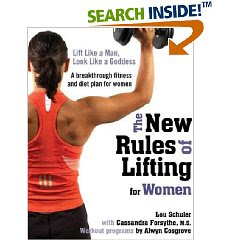
For all the women who are reluctant to lift weights because they fear becoming "too big and bulky," this book is for you. The New Rules of Lifting for Women by Lou Schuler, Alwyn Cosgrove and Cassandra Forsythe dispells the myths that most women still believe about weight training.

This is the best book I have read about weight training for women. It includes a lot of information including some "new rules" all women should follow along with exercise descriptions, six months' worth of training programs, information on why aerobic training is not ideal for fat loss, a chapter on nutrition and numerous meal plans for breakfast, lunch, dinner, pre- and post-workout meals, snacks and dessert.

I highly recommend that all women (and men) pick up a copy of this book. It will change your life forever. You will finally realize that lifting weights won't make you big and bulky and will in fact make you lean, toned and sexy.

Get the book now! You won't regret it and will finally be able to get off the treadmill and other cardio machines and stop wasting your time and start making great progress while transforming your body into the shape you've always dreamed of!

Monday, September 1, 2008

My Current Training Plan - Strength and Speed!

"I discipline my body like an athlete, training it to do what it should. Otherwise, I fear that after preaching to others I myself might be disqualified." - 1 Corinthians 9:27

Earlier this year, I posted my 12-week training plan that helped me increase strength, conditioning and strength endurance while losing about five pounds. I posted the results of that training here - Click me!

Once I finished that program, I spent the next four months (April - July) on fat loss and conditioning programs that included Afterburn 2 and Warp Speed Fat Loss. I lost several more pounds of fat on those programs while increasing my conditioning tremendously, and I only lost a little bit of strength during that time.

Four months is about the maximum amount of time that someone should devote to fat loss training and dieting during the year, as it can be stressful on the body. Thus the reason that I decided to work on maintaining my conditioning and current level of bodyfat while focusing on my strength and speed.

I play ultimate frisbee once each week, so I need to make sure that I am well conditioned. Luckily, the last four months of training prepared me for all the running, sprinting and short rest periods during an intense game. I also know that gaining strength will help me with my overall speed and conditioning.

Currently, I'm on week four of my strength and speed program. I'm actually using the template that Joe Defranco posted in his "Westside for Skinny B*stards III" article. I've made some minor tweaks to fit my goals, but overall, I'm following the same template.

My training week looks like this:


MONDAY – Max-Effort Upper Body

Max-Effort Exercise – I work up to a max of 2-3 sets of 3 reps in some form of pressing exercise. I rotate the exercise every two weeks using a full-range of motion lift for two weeks followed by a partial-range motion exercise for two weeks and repeat every two weeks. For example, I'll peform flat barbell bench presses for two weeks followed by 2- or 3-board presses or floor presses for two weeks and then go to another full-range pressing exercise like close-grip benches or incline benches for two weeks, etc.

Supplemental Exercise – I perform 2 sets of max reps (15-20 reps) or 3-4 sets of 6-8 reps of some sort of pressing exercise (a similar movement as the max-effort exercise).

Horizontal Pulling / Rear Delt Superset - I superset a horizontal pulling movement (rows) with a rear-delt exercise for 2-3 supersets of 8-12 reps of each exercise.

Traps – I perform 2-3 sets of 8-15 reps of some sort of shrugging exercise.

Arms Superset - I perform 2-3 sets of 8-15 reps of a biceps exercise (curls) with a triceps exercise (pushdowns or extensions).

Finisher: I perform sled pushes or another short finisher similar to what I posted in a previous blog.


TUESDAY – Speed Training

General Warm-up / Movement skills (5-15 minutes) – The goal of this portion of the workout is to increase core temperature by performing basic movement skills and calisthenics. (Example: bodyweight squats, jumping jacks, skipping, back pedaling, etc...)

Ground-based mobility (5-15 minutes) – Once I've broken a sweat and my muscles are warm, I perform ground-based mobility drills for 5-15 minutes. (Sample mobility drills include: roll-overs into V-sits, fire hydrant circles, mountain climbers, groiners, etc…)

Frequency drills (2-3 minutes) – I conclude my warm-up with 1 or 2 drills that excite the central nervous system before beginning the speed training portion of the workout. These drills only last 5-10 seconds for 2-3 sets for each. (Example: low pogo jumps, wideouts, ankling, etc.)

Speed training – I follow speed-training techniques for non-athletes (distances of 60 yards or less with complete - or close to it - recovery between sprints). The goal of this workout is to get faster.


WEDNESDAY - Off (or light activity)


THURSDAY – Max-Effort Lower Body & Conditioning

Max-Effort Exercise – I work up to 2 sets of 3 reps or 2-3 singles with 90%. Just like my max-effort upper body day, I rotate the exercise I use every two weeks and use a variety of squatting and deadlifting movements.

Unilateral Movement - I perform 2-3 sets of 8-15 reps of a unilateral quad-dominant exercise such as lunges, step-ups or Bulgarian split squats.

Hip Extension Movement - I perform 2-3 sets of 8-12 reps of a hamstring/posterior chain exercise such as Pull-throughs, Romanian deadlifts, good mornings, etc.

Weighted Abs - I perform a heavy ab exercise for 2-3 sets of 6-12 reps.

Conditioning Finisher – I usually perform one of the following exercises:

1) Sled pushes – I perform 4-6 30-yard sled pushes with about 1 minute rest between sets.

2) Farmer's walks – I perform 4–6 sets of 40 yards with 1-2 minutes rest between sets.

3) Forward or backward sled drags – I perform 4-6 sets of 40-50 yards with 1-2 minutes rest between sets


FRIDAY – Repetition Upper Body

Repetition Exercise – I perform 3 sets of max reps OR 4 sets of 12-15 reps of some sort of pressing exercise.

Vertical Pulling / Rear Delt Superset - I superset a vertical pulling movement (chins, lat pulldowns) with a rear-delt exercise for 2-3 supersets of 8-12 reps of each exercise.

Medial Delts – I peform 2-3 sets of 8-12 reps of dumbbell lateral raises, L-lateral raises, cable lateral raises, dumbbell military presses or a dumbbell side press.

Arms Superset - I perform 2-3 sets of 8-15 reps of a biceps exercise (curls) with a triceps exercise (pushdowns or extensions).

Abs - I perform a bridging (planks) exercise with a rotational exercise (Russian twists) for 2-3 sets for time or reps.

Finisher - If I'm up for it, I'll conclude the workout with a short finisher similar to Monday's workout.


SATURDAY - OFF (this is the day I relax and watch college football most of the day - GO GATORS!).


SUNDAY - Ultimate Frisbee (game day)


Some of the tweaks I've made to Joe Defranco's Strength and Speed template is that I change my supplemental and accessory exercises each week. This is something new I'm trying. Usually, I'll use the same exercise for 4-6 weeks before changing. So this is definitely different than what most trainers may recommend. I've never done this before, so I wanted to see if I can "trick" my body from adapting to any exercise by changing it so frequently. I wouldn't recommend this for a beginner, but it may work well for me since I've been training for so many years.

Also, I change the loading parameters (sets and reps) for my exercises every four weeks. I break up my training (using the template above) into four-week phases. This allows me to use the same set/rep range for all my supplemental and accessory exercises for four weeks (using different exercises each week) before changing the loading parameters (sets and reps) during the next four-week phase.

So that's my current plan that I've been following for the past four weeks and will continue to follow for the next several months.

Thursday, August 7, 2008

Metabolic Acceleration Training - A Better Way!

"Hold firmly to the word of life; then, on the day of Christ’s return, I will be proud that I did not run the race in vain and that my work was not useless." - Philippians 2:16

I'm posting this article originally written by Alwyn Cosgrove about Metabolic Acceleration Training. I've used the various methods below for fat loss and conditioning benefits with good results.

Part One
I'm a huge believer in using the "alternating set" system when training. For time management reasons, I tend to do exercise one for a set, rest 60 seconds or so, do exercise two for a set, rest 60 seconds or so, and continue. This allows me to increase work density while still getting "true" rest.

In other words, I perform a set of squats, rest 60 seconds, perform a set of push-ups, rest 60 seconds, and repeat. So in effect, I've almost tripled the rest period between squat sets (60 seconds plus the time taken for push-ups plus 60 seconds) as opposed to using a straight set system. And for fat loss training, it's unparalleled.

However, the biggest problem or complaint I get from clients who use commercial facilities is that it's really hard for them to tie up two pieces of gym equipment at peak hours. I have my own facility, but I realize this can be a real problem elsewhere. So I started experimenting with a few things - doing dumbbell lunges and push-ups for example or step-ups and dumbbell bench presses where I could use one set of dumbbells and one piece of equipment.

It was an okay compromise, but it started to somewhat limit my exercise selection. And to be honest, it still had the issue of people working in and possibly disrupting your rest periods.

So I went a step further. What if I created a fat loss or conditioning program based around one piece of equipment where you stayed in the same spot, using the same load for the entire duration. So I tried it. At first it was awkward, but after reading Istvan Javorek's work and talking with über strength coach, Robert Dos Remedios, I started to implement different variations of combination lifting.

I just hoped that it would work as well as alternating sets for fat loss and conditioning or at least close enough that it wasn't too much of a tradeoff. As it turns out, it worked better! In fact, it worked so well that it became a cornerstone of my conditioning programs with several athletes.

Part Two
Part two of the evolution of our fat loss programs came shortly after. I have always recommended interval training as a superior form of fat loss over steady state cardio. Interval training is essentially periods of hard work alternated with easier periods of work using a cardio exercise.

The problem - running a mile doing intervals involves about 1,500 repetitions. For someone looking to cut body fat, and hit total body weight training two to three times a week, that is a lot of extra volume and potential joint stress. So I started thinking. Interval training is similar to weight training in that it involves sets (and reps) followed by a rest period (albeit active). What if I used a lighter version of traditional strength training and created metabolic circuits?

Timed Sets
This is the simplest variation of metabolic work. Pick a load that is about 80% of your 10RM. Perform as many reps as possible at a constant tempo for a period of time (e.g. 60 seconds) and try to perform as many repetitions with as good form as possible. Rest for 15-30 seconds and perform another exercise.

Example #1
Barbell reverse lunge, left leg, 60 seconds
Rest 15-30 seconds
Barbell reverse lunge, right leg, 60 seconds
Rest 15-30 seconds
Barbell push press, 60 seconds
Rest 15-30 seconds

Repeat three times for a 12-minute routine.

Example #2
Kettlebell swings, 30 seconds
Rest 15 seconds
Push-ups/burpees, 30 seconds
Rest 15 seconds
Prowler push, 30 seconds
Rest 15 seconds

Repeat for five rounds for a 12-minute finisher.

Metabolic Density Training
This is a modified version of EDT as popularized by Charles Staley. However, Charles recommends two exercises performed as a superset for 15 minutes. In this case, we are going to use three exercises and work for 10 minutes.

Example #1
Dumbbell bench presses
Alternating lunges
Swiss ball crunches

In this method, select a load that will allow 10-12 reps and perform sets of 6-8. There is no rest between exercises. Work continuously for 10 minutes moving from one exercise to the next. The alternate version is to perform five rounds of 6-8 reps of each as fast as possible.

Complexes
Be warned, these are pretty grueling. Perform the complexes at the beginning of your workout when you're fresh. They'll elevate your metabolism beyond anything you've ever experienced before. The most frequently asked question about complexes is how much load to use.

Remember, it's a metabolic stimulus, not a strength or hypertrophy stimulus so be conservative. Now, don't go too light either. A good "Cosgrove rule of thumb" is that if you're not questioning why in the hell you're doing these exercises or convincing yourself that twice around is enough, you're not going heavy enough.

Let's get into it. Perform each complex once per week for four training sessions per week. Use the following progression:

Week one: 4 sets of 5 reps of each, 90 seconds rest
Week two: 5 sets of 5 reps of each, 75 seconds rest
Week three: 5 sets of 6 reps of each, 60 seconds rest
Week four: 6 sets of 6 reps of each, 45 seconds rest.

Then puke.

Complex A
Bent-over barbell row
Hang clean
Front squat and push press hybrid
Jump squat (bar on back)
Good morning

Complex B
Romanian deadlift
Hang clean and front squat and push press (combination lift, perform one rep of each in series)
Reverse lunge (alternate legs)

Complex C
Deadlift
High pull (onto toes)
Squat clean (clean the bar from the hang and then drop into a full squat on the catch)
Military press (strict)
Jump lunges (switch legs)

Insert my evil laugh here!

Complex D
Jump squat
Squat
Squat and hold for 10 seconds
Military press
Push press
Squat and press (combination lift, perform one rep of each in series)

Note: Try to work all exercises at a speed of 1-2 reps per second.

Tabatas
A Tabata protocol is a very high intensity anaerobic interval program that involves eight rounds of 20 second work periods at 170% of your VO2 max with a negative recovery period of 10 seconds. The best way to use these with strength training exercises is to alternate one upper body with one lower body exercise.

The second progression we use is to vary the work-to-rest ratio.

Beginner: 10 seconds work, 20 seconds recovery

Intermediate: 15 seconds work, 15 seconds recovery

Advanced: 20 seconds work, 10 seconds recovery

A great pairing is squat jumps and running push-ups (a single push-up and two reps of mountain climbers in alternating fashion) in pairs.

Medley Conditioning

This is similar to the other methods in that we are working for time, but we will use 15 seconds on and 15 seconds off and perform multiple rounds with different pieces of equipment. For example, an MMA fighter competing in five-minute rounds may use four exercises in a circuit and perform multiple rounds until the five-minute period is up.

Example #1

15 seconds, Prowler push

15 seconds, rest

15 seconds, squat jump

15 seconds, rest

15 seconds, sledgehammer or medicine ball chops

15 seconds, rest

15 seconds, kettlebell swing

15 seconds, rest

Keep working through the medley until the five-minute period is up.

Finishers
Finishers are just short body weight or single piece of equipment only, 3-5 minute routines at the end of each workout.

Screamers:
3 push-ups, 1 tuck jumps

6 push-ups, 2 tuck jumps

9 push-ups, 3 tuck jumps

12 push-ups, 4 tuck jumps

15 push-ups, 5 tuck jumps

Continue to add three push-ups and one tuck jump to each set until you miss a rep. Then climb back down the ladder.

Leg Matrix:
24 squats

12 lunges each leg (alternating)

12 lunge jumps each leg (alternating)

24 squat jumps

(If you can complete this in under 90 seconds, do two rounds with no rest.)

Squat Series:
20-second squat jump

20-second squat

20-second isometric squat

Repeat for three rounds with no rest.

Countdowns
Select two exercises (e.g. kettlebell swing and burpees or squat jumps and plyometric push-ups).
Perform 10 reps of each, 9 reps of each, 8 reps of each and so on. Each week start with one set of one more rep than your top set (e.g. 11 reps, 10 reps, 9 reps, etc.).

A Final Warning
This isn't for the faint hearted or de-conditioned. They are not beginners' routines. If you're coming back from injury or illness, don't try these programs yet. They are brutal. However, if you follow these routines for four weeks, you'll see a very significant improvement in your conditioning and a massive drop in your body fat!

This article originally appeared at EliteFTS.com

Monday, July 14, 2008

An Update on My Training!

"The Lord is my strength and my song; he has given me victory."
- Psalm 118:14

As I mentioned in a previous blog, I'm currently training three days per week following Alwyn Cosgrove's Afterburn 2 training program.

Here's a recap: I performed the first phase (weeks 1-4) of Afterburn 2 during April and early May. Then, Stacey and I started the Warp Speed Fat Loss program for a month. Then I went back to Afterburn 2 beginning with phase 2 (weeks 5-8) in June. I'm on the last phase (weeks 9-12) of the 12-week plan. The current phase looks like this:

Workout A & B (Alternate each workout throughout the week)

Week 1:
Mon - Workout A
Wed - Workout B
Fri - Workout A

Week 2:
Mon - Workout B
Wed - Workout A
Fri - Workout B

Repeat for Weeks 3 and 4

A) Barbell Complex 5x6 (a different barbell complex is performed for Workout A and B)

B1 - B4) Weight Circuits (four exercises using different sets/reps each training day)

C) Ab exercise 2-3 sets of 10-15 reps

D) Finisher x1-2 sets of the Pushup Matrix or Leg Matrix

Recently, I've given myself the time and flexibility within my schedule to train with my Bulldog Kettlebell and Outlaw Rope or to perform some extra bodyweight exercises or go for a bike ride.

Also, I've decided not to perform the metabolic conditioning portion of the original Afterburn 2 workouts (intervals or Tabata's) during the last part of this phase for two reasons:
  1. I have already used interval training and Tabata's at a high intensity 3-5 times a week for the past 12 weeks, and
  2. I'm playing ultimate frisbee on Sunday evenings and need the rest between workouts so I can play well.
Luckily, the past 12 weeks of intense interval training and Tabata's has given me the conditioning needed to play ultimate frisbee with no issues. In the past, even though I was performing intervals 1-2 times per week, I was not prepared for ultimate frisbee and I found myself having problems getting through the game without feeling winded or suffering hamstring soreness and cramping.

Although it has been very difficult, I'm glad I spent the last 12 weeks increasing my conditioning through the use of intervals and Tabata's. And I am able to maintain that level of conditioning now through my weight training sessions (they are metabolically demanding) and from playing ultimate frisbee (and I will add various intervals to my training again in the future).

This has helped me to continue with my fat loss and conditioning goals while not having to train as often as I did during Warp Speed Fat Loss. I am still following the meal plans from Warp Speed Fat Loss and will continue to do so as I like the principles behind how the plan is set up. I have made adjustments as needed (varying the ratios of carbs) to fit with my current training.

I'm also working on designing my next phase of training which will give me a break from what I've been doing and help me continue to make good progress.

Wednesday, June 11, 2008

Warp Speed Fat Loss - Days 23 through 28!

"Come to me, all you who are weary and burdened, and I will give you rest. Take my yoke upon you and learn from me, for I am gentle and humble in heart, and you will find rest for your souls. For my yoke is easy and my burden is light." - Matthew 11:28-30

I must once again apologize for not making consistent updates to my blog about the Warp Speed Fat Loss program. I've been so busy and have had such limited time that I haven't even had a few moments to update my blog for the last week.

I do have a confession to make. I have not trained since last Monday, June 2 (Day 22). As I mentioned in my last blog post, I did my best to stay healthy while traveling to and from the Perform Better Seminar in Rhode Island. Unfortunately, I became very ill after returning home and was sick, sore and too tired to train.

Not only that, but I was swamped at work and at home the entire week. I had a ton of work to catch up on during the week and had a few late nights at work as well as several late nights at home trying to organize some things around the house and catch up on a few chores and projects. I was lucky if I had 5-6 hours of sleep each night for the entire week. I finally had about 8 hours of sleep this past weekend (the end of the program).

However, although I wasn't able to train from Tuesday - Saturday, I still followed the Warp Speed Fat Loss meal plans. Ironically, I lost three pounds during that time period from following the diet only. Prior to this, I had only lost two pounds. That means a total weight loss of five pounds in 28 days on Warp Speed Fat Loss.

Now, that may not seem like much, but you have to remember that I was already fairly lean when I began the program (13-14%), and I have gotten quite a bit leaner while only losing a total of five pounds. This means that I actually gained muscle and lost fat at the same time.

Stacey had reached her lowest weight of 151lbs (a 5-6lb loss) at the end of the third week. However, because I was sick and didn't train during the last week, she took the week off from training. She continued to follow the meal plans during the week, but she did veer from the plan a few times. She ended up gaining back two pounds and ended up at 153lbs (still lower than her starting weight of 157lbs at the beginning of the program).

I have mentioned some of the training-related variety issues that we faced while following the Warp Speed Fat Loss plan in previous blogs, and I will talk about that more in my next blog along with some specific ideas and feedback that I believe to be crucial to the success of the plan.

Not only that, but I recently found out from Mike Roussell that we were not included in the Member's-only section of the site and never received many of the additional email updates and add-ons to the program. This has been fixed, and I just received access to the files as of yesterday!

There are several additional files that would have been helpful to have prior to beginning the program. At least I can go back and read the materials and watch the movie files and listen to the audio files and see if we were on track or missed something along the way that could have accelerated our progress.

Although we are technically finished with the 28-day program, we have decided to continue using the meal plans, but we have switched over to Alwyn Cosgrove's Afterburn 2 program. This is the program I had begun using prior to Warp Speed Fat Loss. It's also very similar in many ways as it utilizes circuits, intervals and a variety of rep ranges throughout the training program.

What I like about Afterburn 2 is that the training is 3-5 days per week (depending on the phase) rather than six days and it uses undulating periodization for the set/rep scheme throughout the same training week.

Also, as I mentioned before, our only true method of interval training is sprinting outside or the use of bodyweight or kettlebell circuits since we don't have access to cardio machines. With Afterburn 2, intervals are performed twice per week and the Tabata method is performed 1-2 times per week. There is also no steady-state cardio on this particular plan. I think this will help us since we have limited access to cardio equipment and will not have the constant pounding of sprinting or jogging aggravating our knees, shins, ankles and feet.

In the current phase, we'll be training three days per week with everything being performed in the same training day. So it looks like this:

Workout A & B (Alternate each workout throughout the week)
Week 1:
Mon - Workout A
Wed - Workout B
Fri - Workout A

Week 2:
Mon - Workout B
Wed - Workout A
Fri - Workout B

Repeat for Week 3 and 4

A) Barbell Complex 5x4 (different complex for Workout A and B)

B1 - B4) Weight Circuits (different exercises and sets/reps each training day)

C) Ab exercise 2-3 sets of 10 reps

D) Finisher x1-2 sets

Cardio A (intervals - 1:1.5 work to rest ratio for 8-10 sets) or Cardio B (Tabata method)

Although there are many similarities to Warp Speed Fat Loss, it is missing the steady-state cardio and uses different frequency and intensity for the interval training. But Afterburn 2 does add the barbell complexes and finishers. In the end, it basically comes down to the same thing: A lot of hard work that creates a huge metabolic disturbance in the body thus raising metabolism and EPOC while burning a lot of calories!

This should definitely help us continue to achieve our fat loss goals while not having to train as often as we did during Warp Speed Fat Loss. Because of our schedule, we can use a few extra days off during the week to rest and also take care of other chores, projects, volunteer activities, etc.

Since we are still following the meal plans and adjusting as needed, we should continue to burn fat and get good results! Also, I will post more about the Warp Speed Fat Loss program in my next blog and possibly a few more. Overall, I highly recommend this program. Although we didn't completely finish the 28 days as written, we did have great success with the program beyond just the fat loss (I'll talk more about that later).